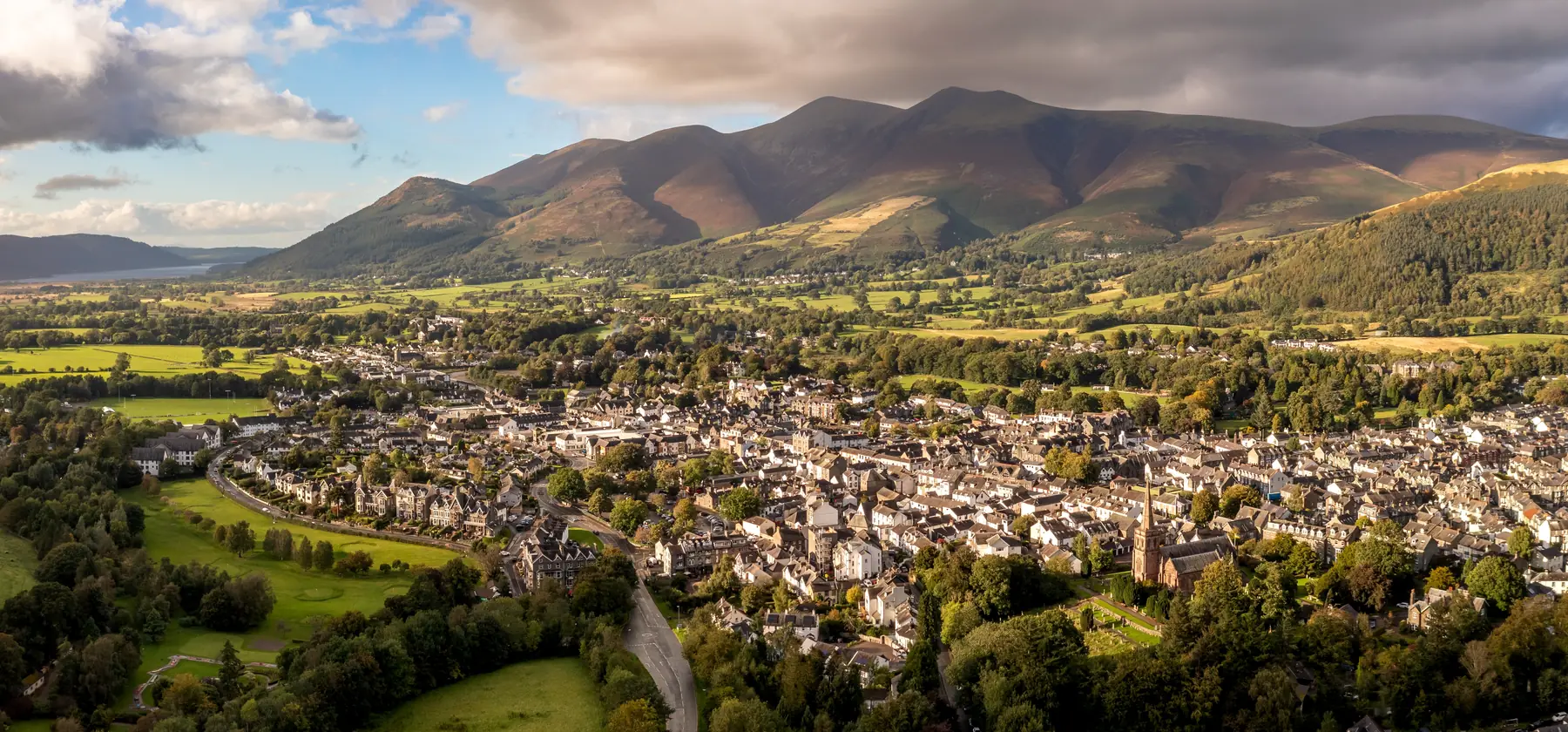
Keswick is a walking town in one of the wettest inhabited corners of England, and the month you pick changes the trip more than the hotel does. The fells, the lake, the car parks and the beds all run on different calendars. A week in May and a week that overlaps the Keswick Convention are not the same holiday.
What follows is the shape of the year, the one event that swallows the town, and the practical reasons to come in September even though the search data barely records anyone asking.
Come in May or September if you want walking weather, open boats and a table. Come in June for long evenings on the ridge. Come in August only on purpose. Come in winter if you like empty shore paths and can live without the high tops. Do not arrive on the third weekend of July without a bed.
Keswick takes something like 1,400 mm of rain a year. Borrowdale, immediately south, is wetter. December is usually the wettest month; spring is usually the driest. That is a pattern, not a promise. Atlantic fronts do not read the guidebook.
The useful consequence is not “avoid winter”. It is: pack waterproofs for Borrowdale in July, and treat a wet day as a theatre and museum day rather than a theft. The town is built for it — museums, a theatre, pubs, Whinlatter under the trees. The rain guide is not a consolation page. It is a normal Keswick page.
Lodore Falls, for the same reason, are a rain feature. A dry fortnight shrinks them. A sequence of fronts is when to go. That is a separate outing, written up here.
The fells green up, the waterfalls still have winter in them, and the paths are emptier than they will be in August. Daffodils at Ullswater are a short drive if you want them. The tops can hold snow into April, so “spring” on Skiddaw is not spring on the shore.
Boats restart in earnest, cafés reopen hours they dropped in January, and you can park after nine without a fight on a midweek morning. It is the season Keswick would advertise if August and the Convention did not pay the bills.
June and early July are the walking gift: long light, Catbells at five o’clock, Derwentwater at nine. Midges find the boggy and wooded bits. Car parks fill. Friars Crag’s single bench becomes a queue — visitors in May and July 2026 said so, and they were not in peak Convention week yet.
If you want the lake and a ridge and a meal, book the meal. If you want solitude on Catbells, do not start at eleven on a Saturday. The Catbells piece is blunt about the lane below the fell.
August is the busiest month even without the Convention’s tail. Families, day-trippers, and everyone who thinks the Lake District is a summer destination arrive together. The walking is still good. The town is not quiet.
This is the fact that catches people who planned a walking week from a map.
The Convention has run since 1875. It is a free evangelical gathering — Bible teaching, worship, a children’s and youth programme — held at the Pencil Factory on Carding Mill Lane. You do not register for the adult meetings. You do register the 3–18s.
2026 dates, from Keswick Ministries:
Three weeks. The town fills. Beds vanish. A visitor to the Pencil Museum in July found a festival next door, no parking, and security to enter the museum. That is not a bad review of the museum. That is the Convention occupying the same corner of Keswick.
If you are coming for the Convention, book yesterday. If you are coming to walk, put those three weeks at the bottom of the list, or stay in Borrowdale and treat Keswick as a supply stop.
2027 is already published in the same pattern, a day earlier: 17 July to 6 August.
This is the season to pick if you can move a date. The woods in Borrowdale turn. The light goes low and gold. Buttermere and Watendlath look like the postcards. Days shorten fast — by late October you want to be off Skiddaw and off Catbells by four.
The boats still run, with a thinner timetable. The car parks breathe again after school goes back. Midges go. Waterproofs stay.
September is the month this site would choose for a first visit: enough opening hours, enough daylight, not the Convention, not the August crush.
The high fells become a serious environment. Skiddaw, Blencathra and Helvellyn in snow are ice-axe and crampon ground, and every year people who did the tourist path in July treat the same line as a winter stroll. Do not.
The low-level walking is at its best for atmosphere and its worst for daylight: the shore path, Castlerigg, Whinlatter, a circuit of Buttermere if the roads are open. Pubs have fires. A lot of seasonal hours drop. The launch is reduced and will cancel in wind.
Castlerigg at dawn in frost is the winter outing that does not require winter mountaineering. Details in the stone circle guide.
Theatre by the Lake sits on the Derwentwater shore and runs a full producing season — 2026 includes Nell Gwynn in July, Calendar Girls the Musical from 6 August to 5 September, and Words by the Water, the literature festival, 11–15 March. Box office 017687 74411; book on the theatre’s site. It is Cumbria’s leading producing house, and it is the reason a wet evening in Keswick is not only a pub.
The Keswick Launch is transport as much as sightseeing. Summer frequency, winter thinning, wind cancellations. Build a Catbells day around it only after you have looked at the day’s sailings.
Market days in the Moot Hall are Thursday and Saturday. That has been true a long time. It is not a festival. It is groceries and stalls under the building that used to be the manor court.
There is no free parking in the centre. Town parks are pay-and-display and they fill before mid-morning on fine weekends, in the school holidays, and between Christmas and New Year — a January visitor found Lakeside packed. Castlerigg has no car park, only a lay-by.
Convention weeks are a special case: treat the Pencil Museum corner as unavailable.
The parking guide is the operational document. This page is only saying: Lakeside packed in January is a warning, and a May midweek at the lakeside machine is a pause.
School holidays move the needle almost as much as the Convention. Easter, the late-May week and October half-term fill the lakeside park and the launch. They do not usually fill the town to Convention density, but they are not “shoulder season” either. If your dates are a half-term, book beds and think of Catbells as an early-or-late hill.
Christmas to New Year is the winter version of the same spike: fewer boats, full car parks, Castlerigg busy at lunchtime, empty at dawn.
May for the fells before the crush, with a waterproof and a winter hat in the bag. June for the evenings. September for the year in miniature. January for Castlerigg and empty woods, if you are not here for Skiddaw.
Late July and the first week of August only if the Convention is the point, or if you have already paid for a cottage and are prepared to walk everywhere.
Keswick does not close. It just gets full, wet, or both. Pick the month that matches the Derwentwater trip you actually want, not the three Convention weeks when half the north is also looking at the fells.