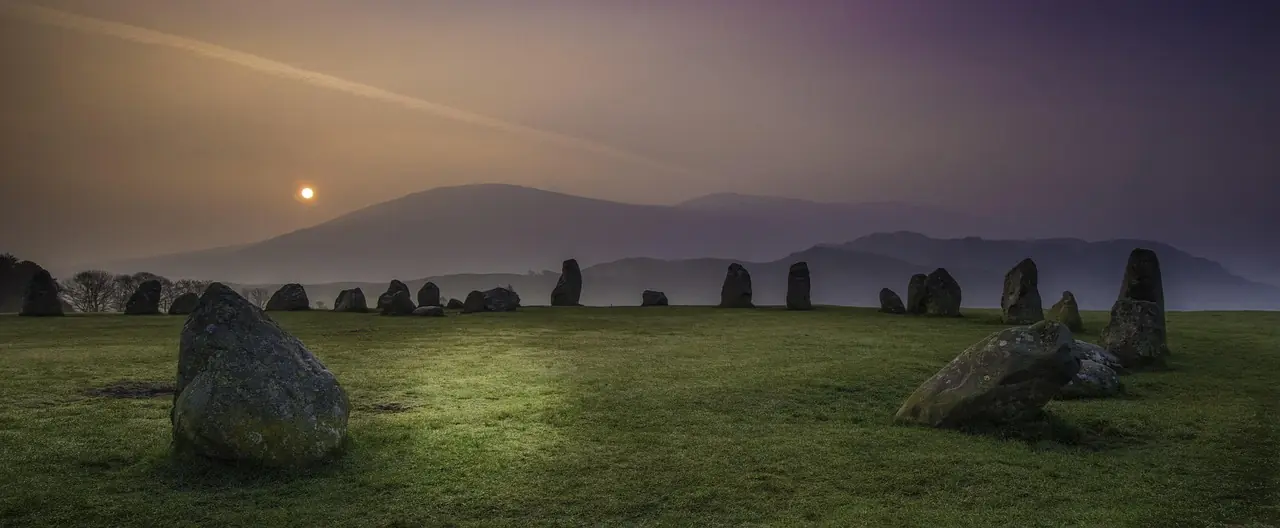
Castlerigg sits on a low plateau two and a half kilometres east of Keswick, and it is one of the earliest stone circles in Britain. It was probably raised around 3200 BC, in the early Neolithic — older, in that form, than the finished Stonehenge, older than the pyramids. Thirty-eight stones stand in a flattened ring about thirty metres across, with a rectangular setting of ten stones, the Sanctuary, inside the eastern arc. You will not find that inner rectangle at another circle.
None of that is why people remember it. They remember the horizon. The circle sits in a bowl of fells: Skiddaw and Blencathra to the north, Helvellyn away east, the Borrowdale hills and Causey Pike south and west. Whoever chose the site chose a 360-degree mountain skyline, and five thousand years have not improved on the decision.
English Heritage and the National Trust look after it between them. They have had the sense to leave it open.
The stones are Borrowdale volcanic rock, glacial erratics gathered from the valley rather than quarried and hauled from a distant outcrop. They are not enormous. The setting does the work that size does at other monuments.
Archaeoastronomers argue over alignments — the tallest stones, midwinter sunrise, notches in the surrounding skyline — with the usual mixture of confidence and guesswork. You do not need a theory. A monument built to sit inside a ring of mountains is doing something obvious, and it still does it.
There is no visitor centre, no ticket hut, no rope. You walk in among the stones. That is the point, and it is also the problem.
English Heritage puts the walk from the centre at about thirty minutes; other local notes put it nearer forty-five, uphill, via Springs Road and the fields. Both can be true depending on where you start and how fast you go. It is a signed route, a proper walk rather than a stroll, and it is the right way to arrive, because it solves the parking.
The circle is the destination of a short hill walk, not a lay-by attraction. Doing it on foot from town also means you can be there at the hour when the lay-by is empty.
Our walks guide puts Castlerigg among the short walks you can do after lunch. That is true. It is better at breakfast.
Castle Lane has a small free lay-by that holds perhaps a dozen cars. It fills. The lane is narrow. On a fine weekend, in the school holidays, and on any evening with a sunset in it, you will not get a space, and you will not enjoy trying.
There is no other car park. Castlerigg is not Hope Park. If you are driving, go early, or be ready to walk from town after one look at the lane. More on the town parks in parking in Keswick.
English Heritage asks people to consider the bus. Stagecoach serves the Keswick area; the last stretch is still on foot.
Because the site is free and unfenced, a fine summer evening can turn it into a public park: picnic blankets, groups, drones, people waiting for the stones to be empty of other people. Visitors who came for solitude and found a crowd say so with some feeling, and they are not wrong.
The fix is timing. Dawn. Winter. Weather that keeps everyone else in town. At seven on a January morning, frost on the stones and the fells white, Castlerigg is one of the most powerful places in England. At four on an August Saturday it is a photograph with twenty other photographs in it.
Sunset is beautiful and busy. Sunrise is beautiful and not.
English Heritage’s current visiting note is worth taking at face value: the ground among the stones is often muddy and slippery, the site is grazed, and dogs are welcome on leads. Sheep and cattle are not a footnote here. If you let a dog run between the stones you are the reason the next notice will be sharper.
There is no shelter. There is no café. There are no toilets. You are on an open hill east of Keswick. Dress for that, not for a monument.
After rain the plateau holds water. After frost it holds ice. The stones will still be there; your trainers may not be the right tool.
Twenty minutes is enough to walk the ring and look at the skyline. An hour is better. People who stay longer are usually waiting for light, or waiting for other people to leave, which is the same thing.
It does not pair well with a rushed morning and a Catbells afternoon unless the circle is the first stop, on foot, before the town is awake. Pairing it with Latrigg, which sits on the same side of town, makes a coherent half-day. Pairing it with the lake is a different direction.
Do not climb on the stones. Do not fly a drone over a circle full of people. Do not light anything. Do not treat “unfenced” as “unmanaged” — it is a scheduled monument, and the two heritage bodies that care for it are trusting you with that.
Do not come only for a photograph of the stones with no fells in it. You can take that photograph at a lot of circles. The point of this one is the bowl.
Winter is when Castlerigg earns the journey. The plateau takes snow when the town does not. The car-shaped crowds stay away. The skyline is sharper. You need a torch for a dawn start, something warm, and honest footwear. You do not need a ticket, a booking, or a forecast good enough for the high fells — you need to be able to walk two and a half kilometres uphill in the dark and two and a half back.
If the high fells are out of bounds, this is still on. That is a useful fact in a town where the hills disappear for days at a time.
Castlerigg is one of the most photographed prehistoric sites in the country, which is another way of saying the quiet hour is scarce. The honest picture includes the fells. A tight shot of three stones with a blue sky could be anywhere. Dawn mist, snow on Blencathra, a midwinter sun on the tallest stones — those are the pictures this place can still give you if you are willing to be cold.
Drones are legal in some of this landscape and a nuisance in all of it when the circle is full. If you must fly, do it at an hour when you would also have the lay-by to yourself. Do not hover over people lying on the grass. The monument is not a studio.
If you have one morning, walk here first. If you have one evening and can live with company, walk here last. If you have a wet day, it is still open — there is no door to close — but the stones in rain are a short visit, and the rest of that day belongs indoors. The Pencil Museum and the rain guide cover that.
Castlerigg is free, always open, and older than almost anything else you will stand in in this country. The only scarce things are a parking space and a quiet hour. Walk from town, go at dawn, keep the dog on a lead, and the rest of the advice on the internet is noise.