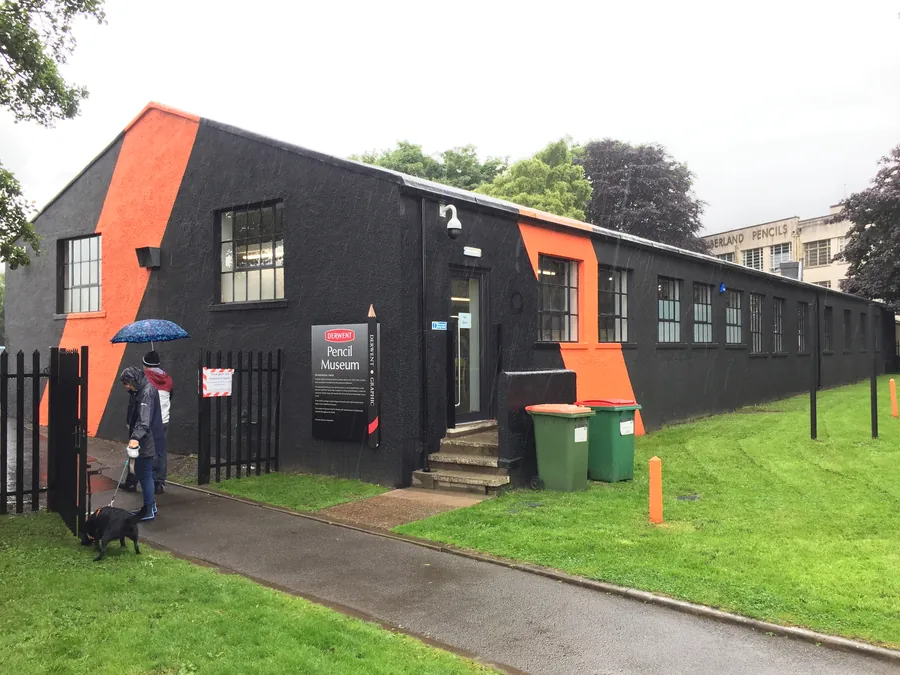
Keswick made pencils because the ground south of town made it possible. Some time in the sixteenth century a deposit of solid graphite — locally wad, or black lead — was found at Seathwaite in Borrowdale. It was the purest large deposit of its kind ever found, and it remains the only one. You could saw it into sticks and write with it. Everything else, including a museum on the old Southey Works site, follows from that accident of geology.
Pencils were made in Keswick from the seventeenth century until 2008. The Derwent Pencil Museum is what the town kept. It is also, on any wet day, the place you will be sent, which is why it is busy in the school holidays and why it is still worth going.
Wad was valuable enough to be guarded, to be flooded between working periods to stop theft, and to be covered by an Act of Parliament in 1752 that made stealing it a felony punishable by transportation. It had a military use as well as a writing one: graphite made smooth moulds for casting cannonballs, which is why the Crown paid attention.
Smuggled wad fed a black market, and local tradition credits a good deal of Keswick’s early money to it. You do not need the tradition to understand the museum. You need it to understand why a small Cumbrian town had a factory at all.
You go in through a replica graphite-mine entrance and then through the history: the Borrowdale deposit, cottage production, the industrial process, clay-and-graphite leads, colour, and the twentieth-century factory. It is more involved than “a museum about pencils” sounds, and the displays work better if you read them than if you drift.
The objects people remember are specific.
The wartime pencils. Charles Fraser-Smith — the quartermaster whose work fed the Bond Q myth — commissioned pencils made here containing a rolled silk map and a compass, issued to RAF aircrew in case they came down over occupied Europe. It is a real object with a real job, and it is the best thing in the building.
The oversized coloured pencil — Derwent’s own page calls it one of the largest in the world, nearly eight metres. The attraction write-up in this site puts it at around 450 kilograms, made in 2001. It is a set-piece, and children find it before they find the history.
The Queen’s Diamond Jubilee pencil, miniature sculptures, original machinery. Enough to hold an hour. Not enough to hold an afternoon unless you are a pencil person, in which case the shop will take the rest of the time.
There is a coffee shop, a gift shop with the current Derwent range, free wifi, baby changing. Well-behaved dogs are welcome.
An hour is the honest visit; ninety minutes if you draw at the stations or have children who want to. It is a family attraction in a way Keswick Museum is not — the rain article on this site is clear that the town museum is for grown-ups and older children, and the Pencil Museum is the one you take younger ones to when the cloud is down.
It is also the one everyone else takes them to. In July the Keswick Convention sets up next door at the Pencil Factory, and a visitor that month found the museum car park unusable and a security process just to get in. If you are here in late July or the first week of August, walk from town and do not treat the on-site park as a given. Convention dates for 2026 are in when to visit Keswick.
Derwent’s own page for 2026 summer opening: 1 April to 1 November, daily 9.30am to 5pm, last admission 4pm. Tickets are on site only. Winter hours are not that timetable; check before you go.
Admission is charged. The 2026 prices were on the operator’s site at the time of writing and will move — read the desk, not a blog. Family tickets and a yearly membership with shop and café discount exist. Under-fives are the usual free case; confirm.
Do not invent a booking. There isn’t one.
The car park outside the museum is not owned by the museum. ANPR cameras are in, payment is on arrival, and the notices on the posts are the rules. Derwent noted it should be open as normal from 13 August 2026 after a disruption; that is a local, dated fact, not a promise about next year.
If you are staying in town, walk. Southey Works is on the north-west edge, a short walk from the centre, about 440 metres in a straight line from the square on the town’s own figures. Fighting ANPR for an hour in a museum is a poor trade.
The rest of Keswick’s parking picture is in the parking guide.
On foot from the market square: ten to fifteen minutes, slightly out of the tourist core.
By car: follow signs for the Pencil Museum, CA12 5NG, then read the car park signs as if they mean it.
During the Convention: assume the immediate area is a festival site. Walk, or come another week.
On a wet day, Puzzling Place is around the corner off the square — small, illusions, queues in the rain. Keswick Museum in Fitz Park is the calmer, more grown-up hour. Theatre by the Lake, down at the water, is the evening. That whole wet-weather stack is in Keswick in the rain.
On a dry day the museum is still worth it if anyone in the party cares about how things are made. It is not a substitute for the lake. Do the lake first, then come here when the landings car park is at its worst and a sit-down hour is the point.
If you have already walked Catbells in the morning, this is a civilised afternoon: indoor, short, and close enough to town that nobody has to get back in the car.
The gift shop is a factory shop in all but name: current Derwent stock, not fridge magnets of Skiddaw. If anyone in the party draws, this is the expensive part of the visit. A yearly membership, when the museum is offering it, knocks a bit off shop and café prices and only makes sense if you are here for a week of wet afternoons or live close enough to come back. For a single holiday hour, pay at the door.
It is not the Borrowdale mine. Seathwaite is a different journey, and the mine is not a visitor attraction in the museum sense. The replica entrance is a device to get you into the story, not a substitute for a fell day.
It is not free. It is not huge. It is not only for children — the wartime pencils and the industrial history are the reason to go as an adult who does not draw.
If it is raining: museum at opening, café, then Puzzling Place or the town museum, then a pub. If it is not: lake or ridge in the morning, museum after lunch when your legs have had enough and the car parks at the landings are at their worst. Either way, buy the ticket at the door, do not trust the on-site park during Convention weeks, and give the silk-map pencil more than a glance. That is the object the rest of the building exists to lead you to.