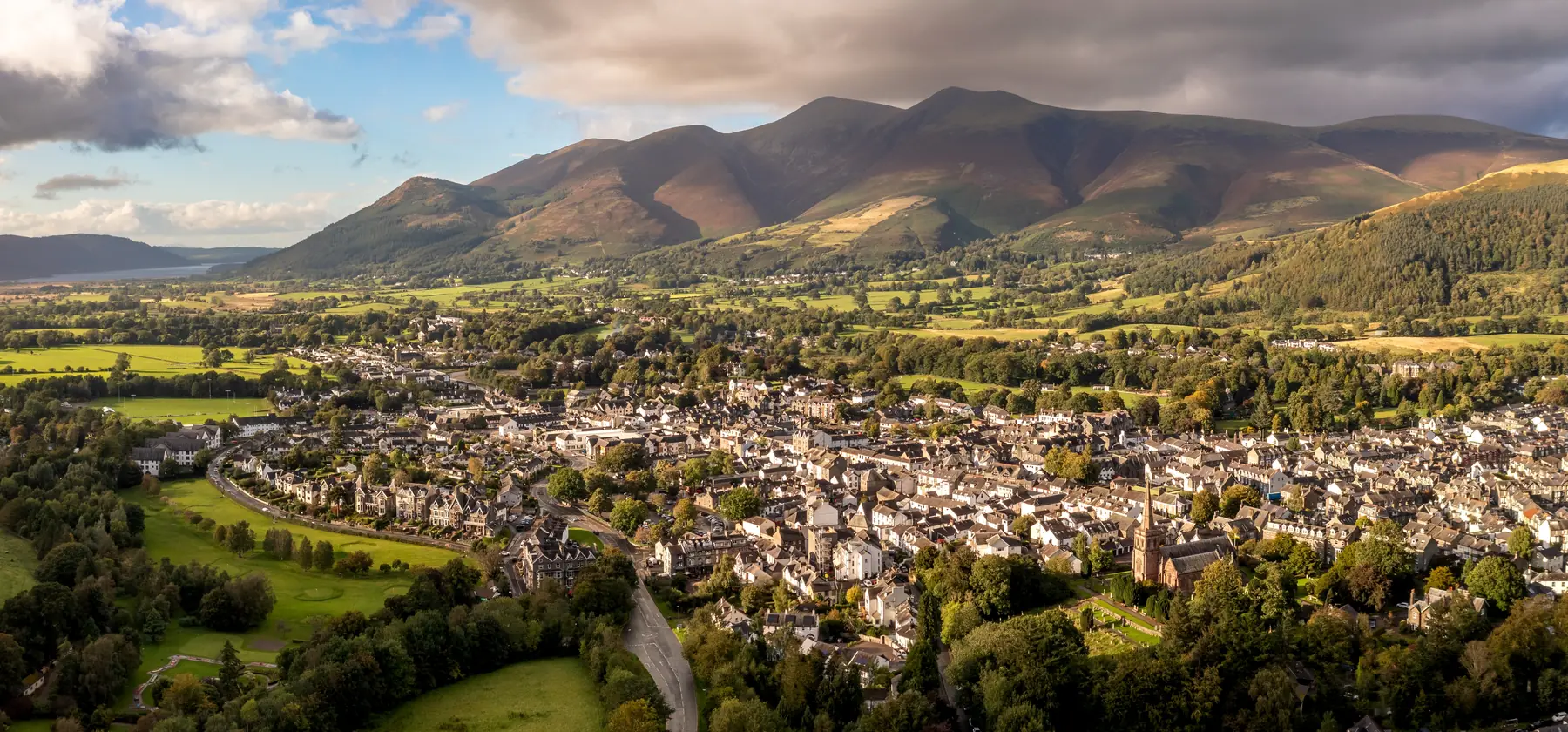
Derwentwater is the reason Keswick exists as a visitor town. It begins at the end of Lake Road, three minutes from the market square, and runs south for three miles into the mouth of Borrowdale, ringed by fells and scattered with wooded islands. It is broad, shallow and — because it is one of the few Lakeland lakes with a proper passenger boat service and a footpath the whole way round — unusually easy to enjoy without any specialist equipment or experience.
This guide covers the ways onto the water, the walk around it, the viewpoints above it, and the practical detail that makes the difference between a good lake day and a frustrating one.
The launch is the single most useful thing on Derwentwater. Small passenger boats run a circuit of jetties around the lake in both directions, and you can join and leave at any of them, which turns the boats into public transport for walkers rather than a sightseeing cruise you sit through.
The jetties, working round from the town, are Keswick, Ashness Gate, Lodore, High Brandelhow, Low Brandelhow, Hawes End and Nichol End. Each opens onto a different part of the lake:
A full circuit without getting off takes roughly fifty minutes. Boats are frequent in summer, reduced in winter, and occasionally cancelled in high wind. Tickets can be bought online or at the office by the landings, and there is a round-the-lake ticket that lets you hop on and off. Visitors consistently rate the crews highly, and the boats are covered, which matters here.
Two marinas sit round the northern shore, both about two kilometres from the town centre and both reachable on foot.
Derwent Water Marina at Portinscale hires kayaks, canoes, paddleboards and sailing dinghies, and runs instruction. Nichol End Marine, a little further along, does the same and is also a launch jetty, so you can arrive by boat and leave by canoe. Both are used to complete beginners; both will put you on the water with a dry bag and clear instructions inside twenty minutes.
Rowing boats are available at the Keswick landings themselves for the simplest possible option: half an hour of pulling about near the shore, which is exactly what most families want.
Derwentwater is a good beginner’s lake — shallow, sheltered by fells, with islands close enough to paddle between. It is also subject to the same sudden wind as any mountain lake, and conditions in the middle can be markedly different from those at the landings.
Four main islands sit in the lake. Derwent Island is the largest and holds a house owned by the National Trust and tenanted; it opens to the public only a handful of days a year, and those days book out. Lord’s Island, St Herbert’s Island and Rampsholme are wooded and uninhabited. St Herbert’s is named for the seventh-century hermit who is said to have lived there, and it is the one people paddle out to.
There is also the Floating Island — a curiosity rather than a place, a mat of vegetation that rises to the surface at the southern end of the lake in some years and not in others.
The full circuit of Derwentwater is about ten miles and takes four to five hours at a comfortable pace. It is almost entirely flat and the going is easy, with one section of road walking near Grange. Most people walk part of it and use the launch for the rest, which is a perfectly respectable way to do it and is what the boats are there for.
The eastern shore, from Keswick past Friars Crag, Calfclose Bay and Great Wood, is the most accessible half and is surfaced for the first stretch. Look for the Hundred Year Stone at Calfclose Bay, a split boulder carved for the National Trust’s centenary and partly submerged when the lake is high. The western shore, through the Brandelhow woods, is quieter, and Brandelhow was the first property the National Trust ever bought in the Lake District.
For the wider walking picture, including the fells above the lake, see our Keswick walks guide.
Derwentwater is a lake that rewards height, and three viewpoints do most of the work.
Friars Crag, fifteen minutes from town on a surfaced path, is the classic — a low promontory looking straight down the lake into Borrowdale. Ruskin called the view from it one of the finest in Europe, and the Victorians took him at his word. The bench at the end is frequently occupied.
Crow Park, between the town and the water, gives almost the same view from a grassy rise with no walking at all.
Walla Crag, three hours round trip up the eastern side, gives the aerial version: the whole lake, the islands laid out below, and Borrowdale beyond.
Surprise View, on the Watendlath road, is the drive-to option and lives up to the name — you come round a bend and the entire lake appears below you. The approach road is steep and narrow.
Open-water swimming has become popular on Derwentwater, and the shallow shelving beaches on the eastern shore near Calfclose Bay are the usual spots. Two practical warnings that come up repeatedly: the stones underfoot are sharp, so bring something to wear on your feet, and the lake is cold year-round — genuinely cold, not bracing.
Parking. Lakeside Car Park on Lake Road is the closest to the landings. Great Wood on the Borrowdale road serves the eastern shore. See our parking guide.
Dogs are welcome on the launch and on the shore paths.
Water levels vary a great deal. After sustained rain the lake rises and parts of the low-lying path near Calfclose Bay can flood; in a dry summer, jetties can sit high above the water.
Wildlife. The lake and its shore hold ospreys in season at nearby Bassenthwaite, red squirrels in the Brandelhow woods, and the vendace — one of Britain’s rarest fish, found in only a handful of lakes.
The half-day circuit. Take the launch clockwise from Keswick, get off at High Brandelhow, walk south through the National Trust woods along the western shore to Low Brandelhow or Hawes End, and pick up the next boat back. Two hours, flat, and it takes in the quietest and most wooded part of the lake.
The Catbells day. Launch to Hawes End, up onto the ridge, along to Hause Gate, then either down to the shore for the boat back or on over Maiden Moor if you want a longer day. Four to five hours in total, and the single most popular walk in the Lake District for good reason.
The full circumnavigation. Ten miles on foot around the whole lake, four to five hours at a comfortable pace, anticlockwise from the town so that the short road section near Grange comes early. Take the launch back from any jetty if the weather or the legs give out — which is exactly what the hop-on ticket is for.
If you have one day, spend it on and around Derwentwater rather than on a fell: the boats, Friars Crag, Crow Park and the shore path give you more of what makes this part of the Lake District distinctive than any single summit will. If you have three, do the lake on the first day to get your bearings, a fell on the second, and Borrowdale or Buttermere on the third. The lake also works as the fallback in poor weather, since the launch runs in rain and the shore path is sheltered — see our wet weather guide for the rest of the options.
Roughly fifty minutes for a full circuit without getting off. Most people break the trip at a jetty and walk.
Yes, and many people do. The eastern shore beaches are the usual places. The water is cold all year and the stones are sharp underfoot.
Different. Windermere is bigger, busier and more developed; Derwentwater is smaller, quieter and better framed by fells, and you can walk round it in an afternoon.
Not usually, though it is sensible in peak weeks. Tickets are available online and at the ticket office by the landings.
Hawes End. It is the busiest stop on the circuit for exactly that reason.