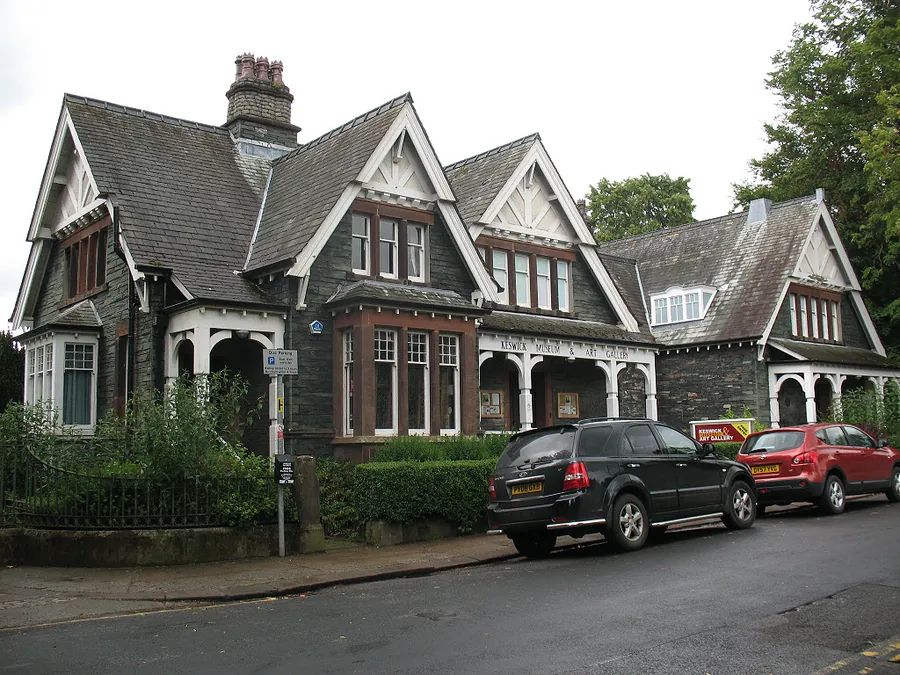
Keswick Museum stands on Station Road at the edge of Fitz Park, five minutes from the market place, in a purpose-built Victorian gallery of 1898 that was refurbished and reopened after a substantial redevelopment.
It is the town’s own museum, covering the landscape, history and culture of the northern Lakes, and it is one of those local collections that turns out to hold a few genuinely remarkable things.
The museum’s most famous object is the Musical Stones of Skiddaw: a large lithophone — a xylophone made of rock — built between 1827 and 1840 by Joseph Richardson, a Keswick stonemason.
Richardson spent thirteen years locating, cutting and tuning hornfels rock from Skiddaw into bars that ring when struck. The finished instrument covered eight octaves, and he and his three sons toured it around Britain as the Rock, Bell and Steel Band, playing for Queen Victoria at Buckingham Palace in 1848.
It is in the museum, and — the crucial point — visitors can play it. That is unusual for an object of this importance and it is what people remember.
Geology — the northern Lakes are a textbook of British geology, and the collection covers the Skiddaw slates, the Borrowdale volcanics and the mineral wealth that made Keswick a mining town long before it was a tourist one.
The Lake Poets — manuscript material relating to Robert Southey, who lived at Greta Hall in Keswick for forty years and is buried at Crosthwaite, and to Coleridge, who lived there before him, and Wordsworth, who came over from Grasmere.
Hugh Walpole material — the novelist lived above Derwentwater and set the Herries Chronicle in Borrowdale.
Natural history, including a well-received display on the curlew, a bird in serious decline whose upland breeding grounds are in this country.
Local industry — mining, pencils, and the Keswick School of Industrial Arts, the Arts and Crafts metalworking school founded by Canon Rawnsley’s wife in 1884.
Interactive elements and a full interactive experience within the displays.
There is a real division in what visitors report, and it is worth passing on.
The museum is beautifully laid out and sits in a relaxing setting beside the park, with a good café — this is close to unanimous.
But some visitors find the entry cost high for the size of the collection, and consider it an adults’ museum rather than a children’s one. That is a fair reading: the interactive elements help, but the substance here is local history and the material rewards someone who reads.
If you want to understand the town and the country around it, it is worth the ticket. If you need to occupy children for two hours in the rain, the Puzzling Place and the Pencil Museum are the better calls.
Admission charged; tickets normally valid for repeat visits over a period — ask.
Time: an hour to ninety minutes.
Location: Station Road, on the edge of Fitz Park, five minutes from the market place.
Facilities: café — well liked — shop, toilets.
Access: the building has been redeveloped and is largely accessible; check for the upper gallery.
Fitz Park alongside is free, with playgrounds, a cricket ground, tennis and the River Greta running through — a good pairing.
A lithophone made from Skiddaw hornfels by Joseph Richardson between 1827 and 1840, played for Queen Victoria in 1848 — and visitors are allowed to play it.
Less than Keswick’s other indoor attractions. It is primarily an adults’ local-history museum, though there are interactive elements.
An hour to ninety minutes.
Station Road, beside Fitz Park, five minutes’ walk from the market place.
Yes, and it is one of the things visitors most consistently praise.