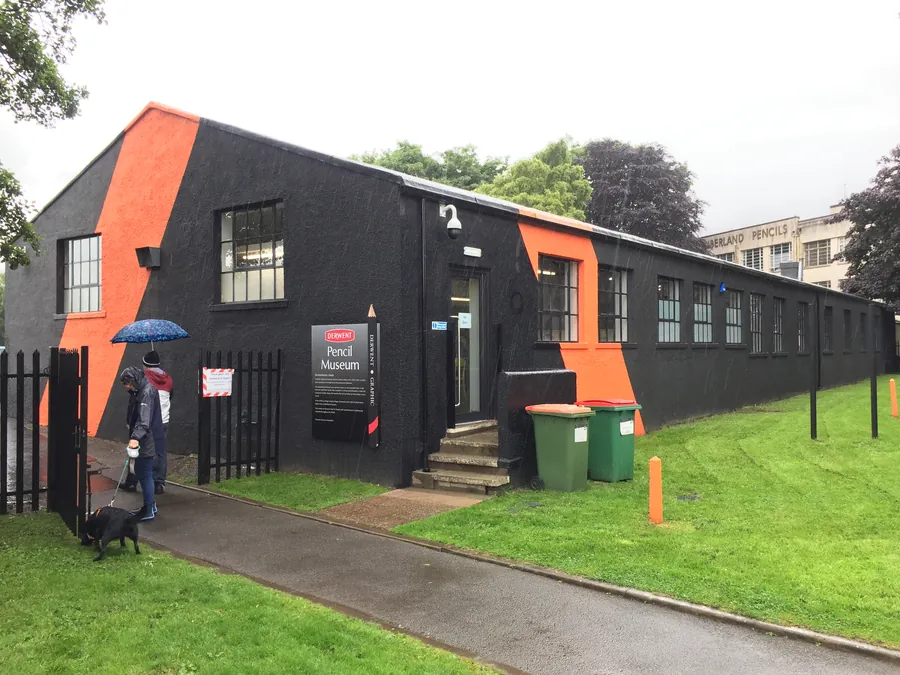
The Derwent Pencil Museum stands at Southey Works on the edge of Keswick, and it exists because of an accident of geology.
Some time in the sixteenth century, a deposit of graphite was found at Seathwaite in Borrowdale, a few miles south. It was the purest and largest deposit of solid graphite ever discovered anywhere in the world, and it remains the only one of its kind ever found. It could be sawn into sticks and used directly.
Everything follows from that. Keswick became the birthplace of the pencil industry, and pencils were made in the town from the seventeenth century until 2008.
The Borrowdale graphite — locally called wad or black lead — was so valuable that the mine was guarded by armed men, flooded deliberately between working periods to prevent theft, and covered by an Act of Parliament of 1752 making stealing it a felony punishable by transportation.
It had a strategic use as well as an artistic one: graphite made the smoothest moulds for casting cannonballs, which is why the Crown took an interest.
Smuggled wad supported a black market and, according to local tradition, a good deal of Keswick’s early prosperity.
The route runs through a mock graphite mine entrance and then through the history: the Borrowdale deposit, the early pencil makers, the industrialisation of the process, the arrival of clay-and-graphite leads, colour manufacture, and the factory’s twentieth century.
The exhibits people remember:
The world’s longest coloured pencil — nearly 8 metres and around 450 kilograms, made in 2001, holding a Guinness record.
The Second World War pencils. Charles Fraser-Smith — the model for Q in the Bond books — commissioned pencils containing a rolled silk map and a compass, made here and issued to RAF aircrew for use if shot down over occupied Europe. It is a genuinely remarkable object, and it is the single best thing in the building.
Original machinery and displays on how a pencil is actually made, which turns out to be more involved than anyone expects.
Artwork in Derwent pencils, some of it startling.
Two things come up over and over.
The quiz. There is a quiz sheet that sends you round the displays looking for answers, with prizes for completing it. Adults as well as children say it is the thing that made them actually read the boards, and it transforms the visit.
The drawing stations. Tables with materials to use, which children stay at far longer than expected.
The staff are consistently praised, and the shop — Derwent’s own — is well stocked and reasonably priced for artists.
School holidays, and especially late July and August. It is a small building, it is the town’s default wet-weather plan, and when Keswick is busy and raining it is packed. Visitors in peak season say plainly that it is not fun in a crowd.
Go early, out of season, or on a fine morning when everyone else is on the fells.
Admission charged, modest.
Time: an hour to ninety minutes with the quiz.
Location: Southey Works, a few minutes’ walk from Keswick town centre.
Parking: on site.
Facilities: small café, large shop, toilets.
Access: level throughout and generally good.
Because the purest solid graphite deposit ever found was at Seathwaite in Borrowdale, a few miles away, discovered in the sixteenth century.
A pencil containing a rolled silk map and a compass, made here for RAF aircrew flying over occupied Europe.
An hour to ninety minutes, particularly if you do the quiz.
Yes — the quiz, the drawing stations and the giant pencil all work well.
School holidays and wet days. It is the town’s standard rainy-day option and gets crowded.