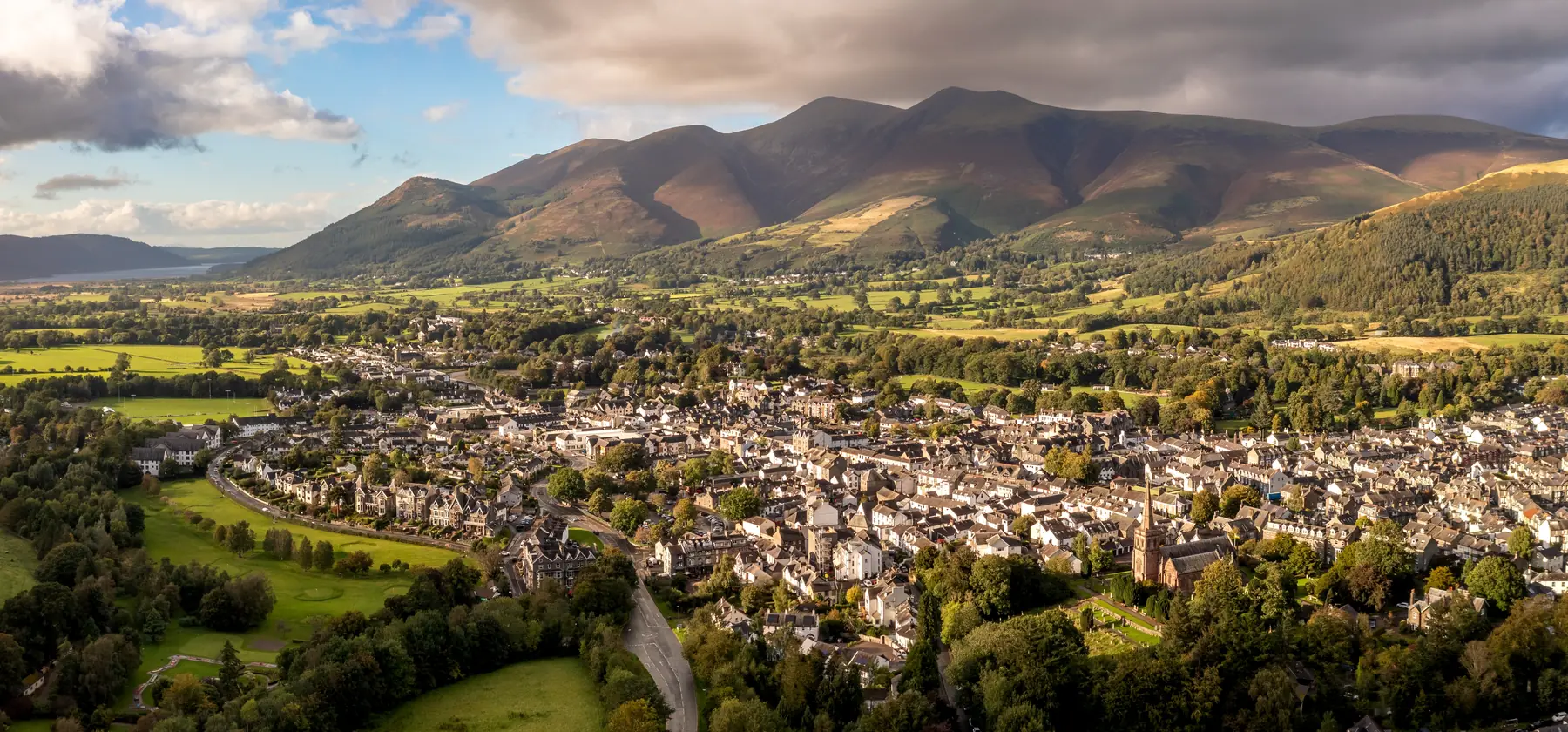
Keswick is an expensive place to sleep and an inexpensive place to spend a day. Almost everything the town is famous for — the lake, the fells, the stone circle, the views from Crow Park and Friars Crag — costs nothing at all, and the paid attractions are largely wet-weather insurance rather than the main event. If you are visiting on a budget, or simply feel that a national park should not require a card reader, here is the full free list.
Friars Crag is the obvious starting point: fifteen minutes from the Moot Hall down Lake Road, past the boat landings, to a wooded promontory looking down the length of Derwentwater into Borrowdale. It is free, it is on a surfaced path, and it is the view that made the Lake District’s reputation with the Victorians. The bench at the end is frequently occupied; the view from ten metres back is nearly as good.
Crow Park, next door, is a bare grassy rise between the town and the water with an uninterrupted sweep of the lake and the Borrowdale fells. Five minutes from the square, no entry, and arguably the single best value in Keswick.
The shore path continues south through Great Wood and Calfclose Bay, where you will find the Hundred Year Stone — a split boulder carved for the National Trust’s centenary that is half-submerged when the lake is high. Walking as far as you like and turning round is the whole activity.
Walking round Derwentwater in full is about ten miles and takes four to five hours. There is a short stretch of road near Grange, and the western shore between the jetties is the quietest part of the lake.
Hope Park is free to walk through, though the golf and boats within it are not. Fitz Park, on the north side of the river, has open lawns, a bandstand, tennis courts and the river path. Upper Fitz Park is the quieter half. All three are within ten minutes of the market square.
Keswick market runs in the square in front of the Moot Hall — a working market rather than a tourist one, and worth timing a visit around.
The Moot Hall itself, the white building with the clock tower in the middle of the square, dates from the eighteenth century and houses the information centre.
Window shopping the outdoor shops is a Keswick institution. So is the Max the Miracle Dog statue on Lake Road, a small memorial that gets more visitors than some paid attractions.
Crosthwaite Church, on the western edge of town, is the parish church of Keswick and free to enter, with a long association with the poet Robert Southey.
Galleries. Several of Keswick’s commercial galleries are free to walk into and are, in effect, small exhibitions of Lakeland landscape painting.
Ashness Bridge, on the Watendlath road above the eastern shore, is the most photographed packhorse bridge in the Lakes. Free, but the small car park fills quickly.
Surprise View, a little further up the same road, is a roadside viewpoint over the whole of Derwentwater. Two minutes from the car park. The road is steep and narrow — worth knowing before you commit a large vehicle to it.
Lodore Falls, at the southern end of the lake, is reached on foot from the shore path and is at its best after heavy rain.
Bassenthwaite Lake viewing points and the Dodd Wood trails north of town are free, and Dodd Wood is one of the better places in England to look for ospreys in season.
Buttermere, eleven kilometres west, has a flat four-and-a-half-mile circuit that many walkers rate as the finest low-level walk in the Lake District. Only the car park costs anything.
A few honest notes. Parking is the main unavoidable cost of a free day out in Keswick — the National Trust car parks are free to members, and the Booths supermarket car park and Crosthwaite Road are the usual free-with-conditions options. Our parking guide sets out where everything is.
If you are staying in Keswick without a car, the town’s compactness is a genuine saving: the lake shore, the fells above the town, the parks and the museums are all walkable, and the bus station is central.
The Keswick Launch is not free, but it is cheap relative to what it saves you in parking and driving, and using it to start a walk turns a ticket into transport rather than a treat.
It is entirely possible to spend a full and satisfying day here without paying for anything but parking and lunch.
Start with the market square and the Moot Hall, then walk out through Hope Park to Crow Park for the first view of the lake — ten minutes, no charge, and the best introduction Keswick has. Continue along the shore to Friars Crag, then carry on into Great Wood and Calfclose Bay to find the Hundred Year Stone. Turn back, or keep going as far as your legs allow; the shore path continues all the way to Borrowdale.
Take lunch on the shore or in Fitz Park, where there is space to sit and a bandstand, then climb Latrigg in the afternoon for the aerial version of the same view. It is two hours from the town and the summit gives you Derwentwater end to end with Skiddaw behind. Come down through the woods, finish in the square, and you will have walked perhaps eight miles, seen the best of the town and the lake, and spent nothing.
A large share of what surrounds Keswick belongs to the National Trust — Great Wood, the Brandelhow woods on the western shore, the Bowder Stone, Watendlath, Derwent Island and much of Borrowdale. If you already hold a membership, the car parks at Great Wood, Watendlath and elsewhere become free, which changes the arithmetic of a walking week considerably. If you do not, it is worth working out how many days you will use before buying one on the spot; for a week in the northern Lakes it very often pays for itself in parking alone.
Yes. It is open at all reasonable times with no admission charge, though the small roadside parking area is limited.
Crow Park for effort-to-reward, Friars Crag for the classic, Walla Crag if you are prepared to climb for it.
Yes. Latrigg, Walla Crag and Skiddaw all start from the town on foot, and the launch reaches the western shore fells.
Fewer, honestly. Crosthwaite Church, the galleries, the market and Whinlatter’s sheltered trails are the main ones — see our wet weather guide for the paid indoor options.
For the bigger picture, our things to do in Keswick page covers the whole range, paid and free.